Tower Defense Patterns
Building Strategic Tower Defense Games
Master tower defense mechanics! Create strategic tower placement, enemy wave systems, upgrade paths, resource management, and special abilities! 🏰🎯💥
Understanding Tower Defense Systems
🎯 Core Tower Defense Mechanics
Great tower defense games balance strategy with action:
- Tower Types: Different towers for different strategies
- Enemy Pathing: Predictable paths with strategic importance
- Wave Systems: Progressive difficulty and variety
- Economy: Resource generation and management
- Upgrades: Tower improvements and specialization
- Special Abilities: Active player intervention
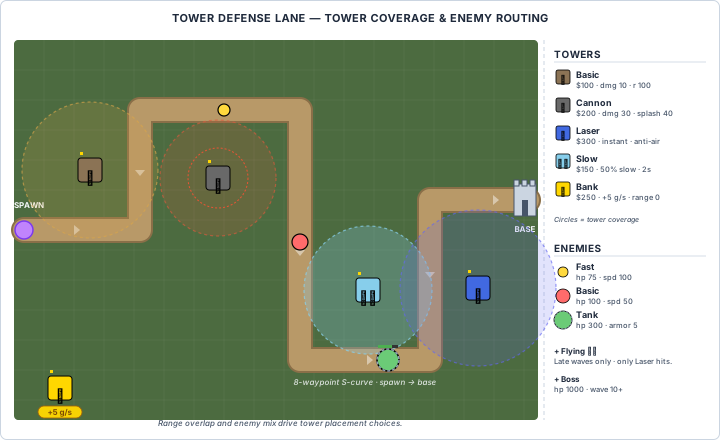
Tower Defense Mathematics
📐 Core Calculations
# Damage Per Second (DPS)
dps = damage * fire_rate

# Effective DPS with armor
effective_damage = max(1, damage - armor)
effective_dps = effective_damage * fire_rate

# Tower efficiency
efficiency = total_damage_dealt / tower_cost

# Range check (circular)
distance = sqrt((enemy.x - tower.x)² + (enemy.y - tower.y)²)
in_range = distance <= tower.range

# Projectile leading (predictive targeting)
time_to_impact = distance / projectile_speed
future_x = enemy.x + enemy.vx * time_to_impact
future_y = enemy.y + enemy.vy * time_to_impact

# Wave difficulty scaling (linear: +10% health per wave - what this lesson's demo uses)
enemy_health = base_health * (1 + wave_number * 0.1)
enemy_count = base_count + floor(wave_number / 5)
Interactive Tower Defense Demo
Build towers to defend against waves of enemies! Click to place towers and upgrade them!
Select Tower:
Tower Defense Implementation in Python
For the complete Python implementation with Pygame, see the Python tower defense code.
Tower Types and Strategies
🏰 Tower Types
- Basic Tower: Balanced damage and fire rate, good against most enemies
- Cannon Tower: High damage with splash effect, slow fire rate
- Laser Tower: Instant hit, high fire rate, good against fast enemies
- Slow Tower: Reduces enemy speed, synergizes with other towers
- Money Tower: Generates income over time, economic investment
Enemy Variety
👾 Enemy Types
- Basic: Standard health and speed
- Fast: Low health but high speed
- Tank: High health and armor, slow movement
- Flying: Can only be hit by certain towers
- Boss: Extremely high health, appears in later waves
Wave System Design
🌊 Wave Mechanics
// Wave composition
const wave = {
    number: 5,
    enemies: [
        { type: 'basic', count: 20, spacing: 600 },
        { type: 'tank', count: 3, spacing: 1500 }
    ],
    bonus: 100,
    difficulty_multiplier: 1.1
};

// Enemy health scaling (exponential x1.1 per wave - an ALTERNATIVE design that ramps
// up faster than the linear formula shown earlier; pick one scheme, not both)
enemy.health = base_health * Math.pow(1.1, wave_number);

// Wave reward calculation
wave_reward = base_reward + (wave_number * 10);

// Spawn timing
spawn_delay = base_delay / (1 + wave_number * 0.05);
Economy Balance
💰 Resource Management
- Starting Gold: Enough for 3-5 basic towers
- Enemy Rewards: Scale with difficulty
- Tower Costs: Exponential upgrade pricing
- Sell Value: 70% of total investment
- Income Generation: Passive income from money towers
- Wave Bonuses: Reward for perfect defense
Advanced Strategies
🎯 Pro Tips
- Maze Building: Force enemies to take longer paths
- Kill Zones: Concentrate firepower at choke points
- Tower Synergy: Combine slow + damage dealers
- Economic Balance: Invest in money towers early
- Upgrade vs Quantity: Few upgraded towers beat many weak ones
- Target Priority: Focus on enemies closest to exit
Best Practices
✨ Tower Defense Best Practices
- Clear Visual Feedback: Show range, damage, and effects clearly
- Predictable Pathing: Players should understand enemy movement
- Meaningful Choices: Each tower type should have a purpose
- Progressive Difficulty: Smooth difficulty curve with spikes
- Resource Tension: Force economic decisions
- Upgrade Paths: Multiple viable strategies
- Special Abilities: Active player engagement beyond placement
- Performance: Handle hundreds of entities smoothly
Key Takeaways
- 🏰 Tower variety creates strategic depth
- 👾 Enemy diversity requires adaptation
- 🌊 Wave systems provide pacing and tension
- 💰 Economy management adds resource strategy
- 🎯 Targeting AI affects effectiveness
- 📈 Upgrade systems provide progression
- 🗺️ Map design influences strategy
- ⚡ Special abilities add active gameplay
🏋️♂️ Practice Exercise
🏋️♂️ Exercise 1: Three Pillars of Tower Defense Architecture — Snapshot-vs-Live-vs-AOE Targeting + PATH-Waypoint-List + WAVES-Composition-Record-List in One Canvas Window
Objective: Build a runnable HTML5 canvas + JS program (~65–75 lines) that distills the lesson's tower-defense architecture into one cohesive demonstration of three orthogonal disciplines visible per frame on a single 900×420 canvas with three integrated regions sharing one scene. (a) Snapshot-vs-live-vs-AOE targeting at TARGETING-EFFECT-TIMING scope — three towers placed beside the path each demonstrating one of the lesson's distinct fire-and-effect timing models: a projectile tower (snapshot-with-leading-shot-prediction) that at fire moment commits to the predicted future target position via targetX = target.x + (dx/dist) * targetSpeed * timeToImpact then flies linearly to the snapshotted point hitting whatever is at that position when it arrives; a laser tower (instant/live) that bypasses projectile entirely and deals damage directly to the current live target via a brief LaserBeam particle drawn on the same frame; a cannon tower (AOE) that snapshots the target at fire moment but on impact damages all live enemies within splash radius via enemies.forEach with (1 - distance/splash) falloff. CONTEXT-DETERMINES-CORRECT-CHOICE pattern: predictive projectile encourages strategic placement (towers shoot ahead, well-placed towers compensate for enemy speed), instant laser encourages reactive placement (laser hits whatever's in range NOW, single-target high-DPS), AOE cannon encourages choke-point placement (clustered enemies all take splash). (b) PATH-waypoint-list data-driven externalization at PATH-WAYPOINT-LIST scope — the module-level PATH array (5 {x, y} waypoint records) IS the canonical route definition that ALL consumers iterate over: enemies walk it via pathIndex for movement, the projectile constructor consumes target.pathIndex + 1 for leading-shot prediction, and the rendering loop draws path segments by walking PATH[i] to PATH[i+1]. R-key swaps to an alternate route from a 2-entry ROUTES dict so the data-driven re-routing is visible: enemies, projectiles, and rendering all pick up the new PATH automatically because they iterate or index into the same array rather than branching on hardcoded coordinates. Adding/changing the route is one array edit. (c) WAVES-composition-record-list data-driven externalization with declarative per-group spacing at WAVE-COMPOSITION-DICT scope — the module-level WAVES array (3 short waves, each {enemies: [{type, count, spacing}]}) IS the canonical wave-pacing declaration; class WaveSpawner consumes by flattening the wave-record into a per-enemy enemyQueues list then time-walking via now - lastSpawn > delay. W-key starts the next wave from the queue, HUD shows currently-spawning enemy types and remaining count per wave. Adding a new wave is ONE record edit (e.g. {enemies: [{type: 'tank', count: 3, spacing: 1500}, {type: 'fast', count: 5, spacing: 400}]}); the spawner picks it up automatically because it iterates the array by WAVES[waveIndex]. Same data-driven externalization pattern as Axis (b), composed into multi-wave timeline data at WAVES-COMPOSITION scope where each wave is a declarative record describing what spawns and how fast.
Instructions:
- Set up a 900×420 canvas with a small
PATHarray of 5{x, y}waypoints describing a simple zig-zag route, plus aROUTESdict with 2 entries (route A and route B) so R-key can swap between them. - Define a small
WAVESarray of 3 records, each{enemies: [{type, count, spacing}]}declaring the per-wave enemy mix and millisecond spacing. - Implement an
Enemyclass that walksPATHviapathIndex/pathProgresswith linear interpolation between waypoints; rendering reads the current PATH array directly so swaps are visible mid-flight. - Implement a
Projectileclass whose constructor snapshots the predicted future target position at fire moment via the leading-shot formulatarget.x + (dx/dist) * targetSpeed * timeToImpactusing thetarget.pathIndex + 1waypoint for direction. - Implement three
Towerinstances representing the three timing models: projectile-tower firesProjectileon cooldown; laser-tower deals damage directly to the live target and pushes a 1-frameLaserBeamparticle; cannon-tower fires aProjectilewith asplashstat that on impact walksenemies.forEachapplying(1 - distance/splash)falloff damage. - Implement
WaveSpawnerthat flattens the active wave's records into a queue and time-walks spawn calls; W-key advances to the next wave and rebuilds the queue. - Wire keys: W to start next wave, R to swap PATH between route A and route B; HUD shows tower-mode legend (P/L/A — projectile snapshot, laser live, cannon AOE), current PATH route active, current wave + enemies remaining.
- Run the loop with
requestAnimationFrameand adt = (now - lastTime)/1000delta; verify all three axes are visible per frame: projectiles flying ahead toward snapshotted positions vs lasers hitting live positions vs cannon splash damaging clustered enemies; PATH swap re-routes everyone instantly; wave progression follows the declarative record-list cadence.
💡 Hint
Keep the three towers stationary at hand-picked positions beside the path so the three timing models are visible side-by-side as enemies walk past. Use {...TOWER_TYPES[type]} spread-copy in the Tower constructor to avoid sharing per-tower stats with the type definition. For the leading-shot prediction, compute distance from tower-to-target, derive timeToImpact = distance / projectileSpeed, then advance the target position by targetSpeed * timeToImpact along the direction toward PATH[target.pathIndex + 1]. The PATH-swap demonstration is most striking when the routes diverge after the spawn point so enemies in flight visibly turn at the moment R is pressed.
✅ Example Solution
// Three Pillars of Tower Defense Architecture — Snapshot-vs-Live-vs-AOE Targeting + PATH-Waypoint-List + WAVES-Composition-Record-List
const c = document.createElement('canvas'); c.width = 900; c.height = 420; document.body.appendChild(c);
const ctx = c.getContext('2d');
// (b) PATH-waypoint-list data-driven externalization — ROUTES dict + active PATH array
const ROUTES = {
  A: [{x:30,y:80}, {x:300,y:80}, {x:300,y:340}, {x:600,y:340}, {x:870,y:340}],
  B: [{x:30,y:80}, {x:200,y:80}, {x:200,y:200}, {x:700,y:200}, {x:870,y:340}]
};
let route = 'A'; let PATH = ROUTES[route];
// (c) WAVES-composition-record-list — declarative per-group spawn cadence
const WAVES = [
  { enemies: [{type:'basic', count:6, spacing:600}] },
  { enemies: [{type:'fast', count:8, spacing:400}, {type:'basic', count:3, spacing:700}] },
  { enemies: [{type:'tank', count:2, spacing:1200}, {type:'basic', count:6, spacing:500}] }
];
const ENEMY_TYPES = { basic:{hp:30,speed:60,size:8,color:'#ff6b6b'}, fast:{hp:18,speed:120,size:6,color:'#ffd93d'}, tank:{hp:90,speed:35,size:11,color:'#6bcb77'} };
class Enemy {
  constructor(type){ Object.assign(this, ENEMY_TYPES[type]); this.maxHp=this.hp; this.pathIndex=0; this.x=PATH[0].x; this.y=PATH[0].y; this.dead=false; }
  update(dt){ if(this.pathIndex>=PATH.length-1){ this.dead=true; return; } const t=PATH[this.pathIndex+1], dx=t.x-this.x, dy=t.y-this.y, d=Math.hypot(dx,dy); if(d<4){ this.pathIndex++; } else { const m=this.speed*dt; this.x+=dx/d*m; this.y+=dy/d*m; } }
  draw(){ ctx.fillStyle=this.color; ctx.beginPath(); ctx.arc(this.x,this.y,this.size,0,Math.PI*2); ctx.fill(); ctx.fillStyle='#0f0'; ctx.fillRect(this.x-12,this.y-this.size-6,24*this.hp/this.maxHp,3); }
}
// (a) Snapshot-vs-live-vs-AOE — three tower modes demonstrating TARGETING-EFFECT-TIMING
const TOWER_TYPES = {
  proj:{range:140,fireRate:1.2,dmg:14,col:'#9bd1ff',pcol:'#ffd700'},
  laser:{range:150,fireRate:3,dmg:6,col:'#ffafaf',pcol:'#00ffff',instant:true},
  cannon:{range:130,fireRate:0.7,dmg:18,col:'#c0a878',pcol:'#ff4500',splash:42}
};
class Projectile {
  constructor(t,target,dmg,sp,col,splash){
    this.x=t.x; this.y=t.y; this.dmg=dmg; this.sp=sp; this.col=col; this.splash=splash; this.dead=false; this.target=target;
    // Leading-shot prediction: snapshot future target position at fire moment
    const dist=Math.hypot(target.x-t.x,target.y-t.y), tti=dist/sp;
    const next=PATH[Math.min(target.pathIndex+1,PATH.length-1)];
    const dx=next.x-target.x, dy=next.y-target.y, d=Math.hypot(dx,dy)||1;
    this.tx=target.x+dx/d*target.speed*tti; this.ty=target.y+dy/d*target.speed*tti;
  }
  update(dt){
    if(this.dead) return;
    const dx=this.tx-this.x, dy=this.ty-this.y, d=Math.hypot(dx,dy);
    if(d<6){
      this.dead=true;
      if(this.splash){ enemies.forEach(e=>{ if(e.dead) return; const ed=Math.hypot(e.x-this.tx,e.y-this.ty); if(ed<=this.splash){ e.hp-=this.dmg*(1-ed/this.splash); if(e.hp<=0) e.dead=true; } }); }
      else if(this.target&&!this.target.dead){ this.target.hp-=this.dmg; if(this.target.hp<=0) this.target.dead=true; }
    } else { this.x+=dx/d*this.sp*dt; this.y+=dy/d*this.sp*dt; }
  }
  draw(){ ctx.fillStyle=this.col; ctx.beginPath(); ctx.arc(this.x,this.y,4,0,Math.PI*2); ctx.fill(); }
}
const beams=[];
class Tower {
  constructor(x,y,type){ this.x=x; this.y=y; this.type=type; Object.assign(this, {...TOWER_TYPES[type]}); this.cd=0; }
  update(dt){
    this.cd-=dt; if(this.cd>0) return;
    const t=enemies.find(e=>!e.dead&&Math.hypot(e.x-this.x,e.y-this.y)<=this.range); if(!t) return;
    this.cd=1/this.fireRate;
    if(this.instant){ t.hp-=this.dmg; if(t.hp<=0) t.dead=true; beams.push({x1:this.x,y1:this.y,x2:t.x,y2:t.y,age:0,col:this.pcol}); }
    else { projectiles.push(new Projectile(this, t, this.dmg, 280, this.pcol, this.splash)); }
  }
  draw(){ ctx.fillStyle=this.col; ctx.fillRect(this.x-12,this.y-12,24,24); ctx.strokeStyle='rgba(255,255,255,0.25)'; ctx.beginPath(); ctx.arc(this.x,this.y,this.range,0,Math.PI*2); ctx.stroke(); ctx.fillStyle='#000'; ctx.font='bold 12px monospace'; ctx.fillText(this.type[0].toUpperCase(),this.x-3,this.y+4); }
}
const towers=[ new Tower(160,180,'proj'), new Tower(450,250,'laser'), new Tower(720,180,'cannon') ];
let enemies=[], projectiles=[], waveIdx=-1, queue=[], lastSpawn=0;
function startWave(){ if(waveIdx>=WAVES.length-1) return; waveIdx++; queue=[]; WAVES[waveIdx].enemies.forEach(g=>{ for(let i=0;i<g.count;i++) queue.push({type:g.type, delay:g.spacing}); }); lastSpawn=performance.now(); }
addEventListener('keydown', e=>{
  if(e.key==='w'||e.key==='W') startWave();
  if(e.key==='r'||e.key==='R'){ route=route==='A'?'B':'A'; PATH=ROUTES[route]; enemies.forEach(en=>{ const i=Math.min(en.pathIndex,PATH.length-1); en.x=PATH[i].x; en.y=PATH[i].y; }); }
});
let last=performance.now();
function loop(now){
  const dt=Math.min((now-last)/1000,0.1); last=now;
  if(queue.length>0 && now-lastSpawn>queue[0].delay){ enemies.push(new Enemy(queue.shift().type)); lastSpawn=now; }
  enemies.forEach(e=>e.update(dt)); enemies=enemies.filter(e=>!e.dead);
  towers.forEach(t=>t.update(dt)); projectiles.forEach(p=>p.update(dt)); projectiles=projectiles.filter(p=>!p.dead); beams.forEach(b=>b.age+=dt);
  ctx.fillStyle='#1a2e1a'; ctx.fillRect(0,0,c.width,c.height);
  ctx.strokeStyle='#8b7355'; ctx.lineWidth=22; ctx.lineCap='round'; ctx.beginPath(); ctx.moveTo(PATH[0].x,PATH[0].y); for(let i=1;i<PATH.length;i++) ctx.lineTo(PATH[i].x,PATH[i].y); ctx.stroke();
  beams.filter(b=>b.age<0.08).forEach(b=>{ ctx.strokeStyle=b.col; ctx.lineWidth=2; ctx.beginPath(); ctx.moveTo(b.x1,b.y1); ctx.lineTo(b.x2,b.y2); ctx.stroke(); });
  towers.forEach(t=>t.draw()); enemies.forEach(e=>e.draw()); projectiles.forEach(p=>p.draw());
  ctx.fillStyle='#fff'; ctx.font='12px monospace';
  ctx.fillText(`Wave ${waveIdx+1}/${WAVES.length}  Enemies left: ${enemies.length+queue.length}  Route: ${route}`, 10, 16);
  ctx.fillText('Towers: P=projectile snapshot, L=laser live, A=cannon AOE   Keys: W next wave, R swap route', 10, 410);
  requestAnimationFrame(loop);
}
requestAnimationFrame(loop);
🎯 Quick Quiz
Question 1: The demo's projectile tower commits to a predicted future target position at fire moment (snapshot+lead), the laser tower deals damage directly to the current live target with no flight time, and the cannon tower snapshots the target at fire moment then on impact damages all enemies within a splash radius. Why does the lesson expose THREE distinct fire-and-effect timing models rather than collapsing them into one?
Question 2: The demo's PATH array is consumed by enemies for movement (via pathIndex), by projectiles for leading-shot prediction (via target.pathIndex + 1), and by the rendering loop for path drawing. R-key swaps the PATH from route A to route B in a 2-entry ROUTES dict and all three consumers pick up the new route automatically. Why is the route stored as an array consumed by all three systems rather than hardcoded as separate movement code, separate prediction code, and separate rendering code?
Question 3: The demo's WAVES array stores 3 records, each {enemies: [{type, count, spacing}]}. WaveSpawner consumes this by flattening the active wave's record into a per-enemy queue then time-walking via now - lastSpawn > delay. Adding a new wave like {enemies: [{type: 'tank', count: 3, spacing: 1500}, {type: 'fast', count: 5, spacing: 400}]} requires no changes to the spawner code. Why is wave composition stored as declarative records rather than hardcoded into the spawner's control flow?
What's Next?
Congratulations on completing the game genres section! You've learned puzzle mechanics, racing physics, and tower defense patterns. Continue exploring other advanced topics in game development!