Particle Effects
Creating Magic with Particles
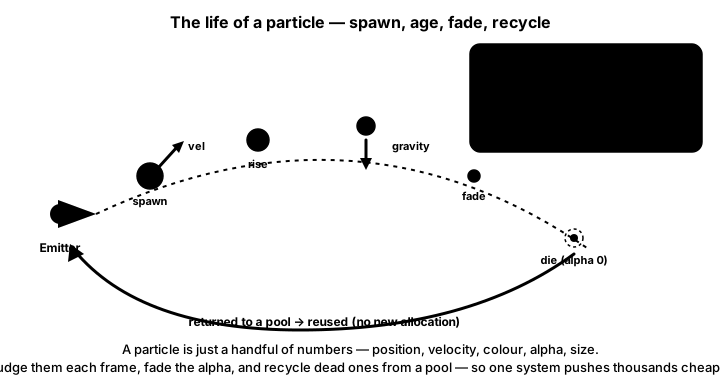
Particle effects bring your game to life with explosions, fire, smoke, sparks, and magical effects! They're the visual spice that makes actions feel impactful and worlds feel alive. Let's master the art of particle systems! ✨🎆
Understanding Particle Systems
🎆 The Fireworks Analogy
Think of particle systems like fireworks:
- Emitter: The launcher that creates particles
- Particles: Individual sparks with their own life
- Properties: Color, size, velocity, lifetime
- Forces: Gravity, wind, attraction/repulsion
- Death: Particles fade or disappear after their lifetime
Interactive Particle Effects Playground
Click to create effects! Explore different particle systems!
Effect: Explosion | Particles: 0
Basic Particle System
import pygame
import random
import math

class Particle:
    def __init__(self, x, y):
        self.x = x
        self.y = y
        self.vx = random.uniform(-2, 2)
        self.vy = random.uniform(-5, -1)
        self.lifetime = random.uniform(0.5, 1.5)
        self.size = random.randint(2, 5)
        self.color = (255, random.randint(100, 255), 0)
        self.gravity = 0.2

    def update(self, dt):
        # Physics
        self.vx *= 0.99  # Air resistance
        self.vy += self.gravity

        # Movement
        self.x += self.vx
        self.y += self.vy

        # Age
        self.lifetime -= dt

        # Fade color
        fade_factor = max(0, self.lifetime)
        self.color = (
            int(255 * fade_factor),
            int(self.color[1] * fade_factor),
            0
        )

        return self.lifetime > 0

    def draw(self, screen):
        if self.lifetime > 0:
            pygame.draw.circle(screen, self.color,
                             (int(self.x), int(self.y)),
                             self.size)

class ParticleSystem:
    def __init__(self):
        self.particles = []

    def emit(self, x, y, count=10):
        """Create new particles"""
        for _ in range(count):
            self.particles.append(Particle(x, y))

    def update(self, dt):
        """Update all particles"""
        # Update particles and remove dead ones
        self.particles = [p for p in self.particles if p.update(dt)]

    def draw(self, screen):
        """Draw all particles"""
        for particle in self.particles:
            particle.draw(screen)

    def clear(self):
        """Remove all particles"""
        self.particles.clear()

    def count(self):
        """Get particle count"""
        return len(self.particles)
Advanced Particle Effects
# Configurable particle system
class ConfigurableParticle:
    def __init__(self, x, y, config):
        self.x = x
        self.y = y

        # Velocity with spread
        angle = random.uniform(config.angle - config.spread,
                             config.angle + config.spread)
        speed = random.uniform(config.speed_min, config.speed_max)
        self.vx = math.cos(angle) * speed
        self.vy = math.sin(angle) * speed

        # Properties
        self.lifetime = random.uniform(config.lifetime_min, config.lifetime_max)
        self.max_lifetime = self.lifetime
        self.size = random.uniform(config.size_min, config.size_max)
        self.start_size = self.size

        # Color
        if config.color_variation:
            h = config.hue + random.randint(-config.hue_variation, config.hue_variation)
            s = config.saturation
            v = config.value
            self.color = self.hsv_to_rgb(h, s, v)
        else:
            self.color = config.color

        # Physics
        self.gravity = config.gravity
        self.damping = config.damping
        self.wind = config.wind

        # Behavior flags
        self.fade = config.fade
        self.shrink = config.shrink
        self.glow = config.glow

    def hsv_to_rgb(self, h, s, v):
        """Convert HSV to RGB"""
        import colorsys
        r, g, b = colorsys.hsv_to_rgb(h/360, s, v)
        return (int(r*255), int(g*255), int(b*255))

    def update(self, dt):
        # Apply forces
        self.vy += self.gravity * dt
        self.vx += self.wind * dt

        # Apply damping
        self.vx *= (1 - self.damping * dt)
        self.vy *= (1 - self.damping * dt)

        # Update position
        self.x += self.vx * dt
        self.y += self.vy * dt

        # Update lifetime
        self.lifetime -= dt

        # Update size
        if self.shrink:
            life_ratio = self.lifetime / self.max_lifetime
            self.size = self.start_size * life_ratio

        return self.lifetime > 0

    def draw(self, screen):
        # Calculate alpha
        alpha = 255
        if self.fade:
            alpha = int(255 * (self.lifetime / self.max_lifetime))

        # Draw glow effect
        if self.glow and alpha > 0:
            glow_surf = pygame.Surface((self.size * 4, self.size * 4), pygame.SRCALPHA)
            pygame.draw.circle(glow_surf, (*self.color, alpha // 4),
                             (self.size * 2, self.size * 2), self.size * 2)
            screen.blit(glow_surf, (self.x - self.size * 2, self.y - self.size * 2),
                       special_flags=pygame.BLEND_ADD)

        # Draw particle
        if alpha > 0:
            particle_surf = pygame.Surface((self.size * 2, self.size * 2), pygame.SRCALPHA)
            pygame.draw.circle(particle_surf, (*self.color, alpha),
                             (self.size, self.size), self.size)
            screen.blit(particle_surf, (self.x - self.size, self.y - self.size))

class ParticleConfig:
    """Configuration for particle behavior"""
    def __init__(self):
        # Emission
        self.angle = -math.pi / 2  # Upward
        self.spread = math.pi / 4  # 45 degree spread
        self.speed_min = 50
        self.speed_max = 150

        # Lifetime
        self.lifetime_min = 0.5
        self.lifetime_max = 1.5

        # Appearance
        self.size_min = 2
        self.size_max = 6
        self.color = (255, 100, 0)
        self.hue = 30  # Orange
        self.saturation = 1.0
        self.value = 1.0
        self.color_variation = True
        self.hue_variation = 30

        # Physics
        self.gravity = 100
        self.damping = 0.1
        self.wind = 0

        # Behavior
        self.fade = True
        self.shrink = True
        self.glow = False

# Particle emitter
class ParticleEmitter:
    def __init__(self, x, y, config, system):
        self.x = x
        self.y = y
        self.config = config
        self.system = system
        self.active = True

        # Emission settings
        self.emission_rate = 30  # particles per second
        self.burst_count = 0  # 0 for continuous
        self.emission_timer = 0

        # Lifetime
        self.lifetime = -1  # -1 for infinite
        self.age = 0

    def update(self, dt):
        if not self.active:
            return

        # Update age
        self.age += dt

        # Check lifetime
        if self.lifetime > 0 and self.age >= self.lifetime:
            self.active = False
            return

        # Emit particles
        if self.burst_count > 0:
            # Burst emission
            for _ in range(self.burst_count):
                self.emit_particle()
            self.active = False  # One-shot burst
        else:
            # Continuous emission
            self.emission_timer += dt
            particles_to_emit = int(self.emission_timer * self.emission_rate)

            if particles_to_emit > 0:
                for _ in range(particles_to_emit):
                    self.emit_particle()
                self.emission_timer -= particles_to_emit / self.emission_rate

    def emit_particle(self):
        """Create a single particle"""
        # Add position variation
        x = self.x + random.uniform(-5, 5)
        y = self.y + random.uniform(-5, 5)

        particle = ConfigurableParticle(x, y, self.config)
        self.system.particles.append(particle)
Specialized Particle Effects
# Fire effect
class FireEffect(ParticleEmitter):
    def __init__(self, x, y, system):
        config = ParticleConfig()
        config.angle = -math.pi / 2
        config.spread = math.pi / 6
        config.speed_min = 30
        config.speed_max = 60
        config.lifetime_min = 0.3
        config.lifetime_max = 0.8
        config.size_min = 3
        config.size_max = 8
        config.hue = 30
        config.hue_variation = 30
        config.gravity = -50  # Fire rises
        config.wind = random.uniform(-20, 20)
        config.fade = True
        config.shrink = True
        config.glow = True

        super().__init__(x, y, config, system)
        self.emission_rate = 50

# Smoke effect
class SmokeEffect(ParticleEmitter):
    def __init__(self, x, y, system):
        config = ParticleConfig()
        config.angle = -math.pi / 2
        config.spread = math.pi / 4
        config.speed_min = 10
        config.speed_max = 30
        config.lifetime_min = 1.0
        config.lifetime_max = 2.0
        config.size_min = 10
        config.size_max = 20
        config.color = (100, 100, 100)
        config.color_variation = False
        config.gravity = -20
        config.wind = 10
        config.fade = True
        config.shrink = False
        config.glow = False

        super().__init__(x, y, config, system)
        self.emission_rate = 20

# Explosion effect
class ExplosionEffect:
    def __init__(self, x, y, system):
        self.x = x
        self.y = y
        self.system = system
        self.create_explosion()

    def create_explosion(self):
        # Main explosion particles
        config = ParticleConfig()
        config.spread = math.pi * 2  # Full circle
        config.speed_min = 100
        config.speed_max = 300
        config.lifetime_min = 0.3
        config.lifetime_max = 0.6
        config.size_min = 3
        config.size_max = 8
        config.hue = 30
        config.hue_variation = 60
        config.gravity = 50
        config.damping = 0.5
        config.fade = True
        config.shrink = True
        config.glow = True

        # Create burst
        for _ in range(50):
            particle = ConfigurableParticle(self.x, self.y, config)
            self.system.particles.append(particle)

        # Add smoke
        smoke_config = ParticleConfig()
        smoke_config.spread = math.pi * 2
        smoke_config.speed_min = 20
        smoke_config.speed_max = 50
        smoke_config.lifetime_min = 1.0
        smoke_config.lifetime_max = 2.0
        smoke_config.size_min = 15
        smoke_config.size_max = 25
        smoke_config.color = (50, 50, 50)
        smoke_config.color_variation = False
        smoke_config.gravity = -10
        smoke_config.fade = True

        for _ in range(20):
            particle = ConfigurableParticle(self.x, self.y, smoke_config)
            self.system.particles.append(particle)

# Magic sparkles
class MagicSparkles(ParticleEmitter):
    def __init__(self, x, y, system):
        config = ParticleConfig()
        config.spread = math.pi * 2
        config.speed_min = 20
        config.speed_max = 50
        config.lifetime_min = 0.5
        config.lifetime_max = 1.5
        config.size_min = 1
        config.size_max = 3
        config.hue = 270  # Purple
        config.hue_variation = 60
        config.gravity = -20
        config.fade = True
        config.shrink = True
        config.glow = True

        super().__init__(x, y, config, system)
        self.emission_rate = 30

    def emit_particle(self):
        """Override to add spiral motion"""
        particle = ConfigurableParticle(self.x, self.y, self.config)

        # Add spiral motion
        angle = self.age * 5
        radius = 30
        offset_x = math.cos(angle) * radius
        offset_y = math.sin(angle) * radius

        particle.x += offset_x
        particle.y += offset_y

        self.system.particles.append(particle)
Complete Particle System Demo
import pygame
import random
import math

class ParticleSystemDemo:
    def __init__(self):
        pygame.init()
        self.screen = pygame.display.set_mode((800, 600))
        pygame.display.set_caption("Particle Effects Demo")
        self.clock = pygame.time.Clock()

        # Particle system
        self.particle_system = AdvancedParticleSystem()

        # Emitters
        self.emitters = []

        # Demo settings
        self.current_effect = 'fire'
        self.show_info = True

        # Create initial effects
        self.setup_demo_effects()

    def setup_demo_effects(self):
        """Create demonstration effects"""
        # Campfire
        fire = FireEffect(200, 400, self.particle_system)
        self.emitters.append(fire)

        # Magic fountain
        magic = MagicSparkles(600, 400, self.particle_system)
        self.emitters.append(magic)

    def handle_events(self):
        for event in pygame.event.get():
            if event.type == pygame.QUIT:
                return False
            elif event.type == pygame.MOUSEBUTTONDOWN:
                x, y = pygame.mouse.get_pos()

                if event.button == 1:  # Left click
                    self.create_effect(self.current_effect, x, y)
                elif event.button == 3:  # Right click
                    self.create_effect('explosion', x, y)
            elif event.type == pygame.KEYDOWN:
                if event.key == pygame.K_1:
                    self.current_effect = 'fire'
                elif event.key == pygame.K_2:
                    self.current_effect = 'smoke'
                elif event.key == pygame.K_3:
                    self.current_effect = 'explosion'
                elif event.key == pygame.K_4:
                    self.current_effect = 'magic'
                elif event.key == pygame.K_5:
                    self.current_effect = 'sparks'
                elif event.key == pygame.K_c:
                    self.particle_system.clear()
                    self.emitters.clear()
                elif event.key == pygame.K_i:
                    self.show_info = not self.show_info

        return True

    def create_effect(self, effect_type, x, y):
        """Create particle effect at position"""
        if effect_type == 'fire':
            emitter = FireEffect(x, y, self.particle_system)
            emitter.lifetime = 3  # 3 seconds
            self.emitters.append(emitter)
        elif effect_type == 'smoke':
            emitter = SmokeEffect(x, y, self.particle_system)
            emitter.lifetime = 3
            self.emitters.append(emitter)
        elif effect_type == 'explosion':
            ExplosionEffect(x, y, self.particle_system)
        elif effect_type == 'magic':
            emitter = MagicSparkles(x, y, self.particle_system)
            emitter.lifetime = 3
            self.emitters.append(emitter)
        elif effect_type == 'sparks':
            self.create_spark_burst(x, y)

    def create_spark_burst(self, x, y):
        """Create burst of sparks"""
        config = ParticleConfig()
        config.spread = math.pi * 2
        config.speed_min = 100
        config.speed_max = 200
        config.lifetime_min = 0.5
        config.lifetime_max = 1.0
        config.size_min = 1
        config.size_max = 2
        config.color = (255, 255, 100)
        config.gravity = 200
        config.fade = True
        config.glow = True

        for _ in range(30):
            particle = ConfigurableParticle(x, y, config)
            self.particle_system.particles.append(particle)

    def update(self, dt):
        # Update emitters
        for emitter in self.emitters[:]:
            emitter.update(dt)
            if not emitter.active:
                self.emitters.remove(emitter)

        # Update particle system
        self.particle_system.update(dt)

    def draw(self):
        # Clear screen
        self.screen.fill((20, 20, 30))

        # Draw ground
        pygame.draw.rect(self.screen, (40, 40, 40), (0, 450, 800, 150))

        # Draw particles
        self.particle_system.draw(self.screen)

        # Draw emitter positions
        for emitter in self.emitters:
            if emitter.active:
                pygame.draw.circle(self.screen, (255, 255, 0, 50),
                                 (int(emitter.x), int(emitter.y)), 5, 1)

        # Draw UI
        if self.show_info:
            self.draw_ui()

    def draw_ui(self):
        """Draw user interface"""
        font = pygame.font.Font(None, 24)

        # Effect selection
        effects = ['1: Fire', '2: Smoke', '3: Explosion', '4: Magic', '5: Sparks']
        y_offset = 10

        for i, text in enumerate(effects):
            color = (255, 255, 0) if text.split(':')[1].strip().lower() == self.current_effect else (200, 200, 200)
            rendered = font.render(text, True, color)
            self.screen.blit(rendered, (10, y_offset))
            y_offset += 30

        # Instructions
        instructions = [
            f"Current: {self.current_effect}",
            f"Particles: {self.particle_system.count()}",
            f"Emitters: {len(self.emitters)}",
            "",
            "Left Click: Create Effect",
            "Right Click: Explosion",
            "C: Clear All",
            "I: Toggle Info"
        ]

        y_offset = 10
        for text in instructions:
            rendered = font.render(text, True, (255, 255, 255))
            self.screen.blit(rendered, (600, y_offset))
            y_offset += 25

    def run(self):
        running = True
        dt = 0

        while running:
            running = self.handle_events()
            self.update(dt / 1000.0)  # Convert to seconds
            self.draw()
            pygame.display.flip()
            dt = self.clock.tick(60)

        pygame.quit()

class AdvancedParticleSystem:
    def __init__(self):
        self.particles = []
        self.max_particles = 5000

    def update(self, dt):
        """Update all particles"""
        # Update particles and remove dead ones
        self.particles = [p for p in self.particles
                         if p.update(dt)]

        # Limit particle count
        if len(self.particles) > self.max_particles:
            self.particles = self.particles[-self.max_particles:]

    def draw(self, screen):
        """Draw all particles with blending"""
        # Create surface for additive blending
        particle_surf = pygame.Surface(screen.get_size())
        particle_surf.fill((0, 0, 0))

        # Draw particles to surface
        for particle in self.particles:
            particle.draw(particle_surf)

        # Blend with main screen
        screen.blit(particle_surf, (0, 0), special_flags=pygame.BLEND_ADD)

    def clear(self):
        """Remove all particles"""
        self.particles.clear()

    def count(self):
        """Get particle count"""
        return len(self.particles)

if __name__ == "__main__":
    demo = ParticleSystemDemo()
    demo.run()
Performance Optimization
⚡ Particle System Optimization
- Object Pooling: Reuse particle objects instead of creating new
- LOD System: Reduce particles based on distance
- Batch Rendering: Draw similar particles together
- Spatial Partitioning: Only update visible particles
- GPU Particles: Use shaders for massive particle counts
- Texture Atlas: One texture for all particle types
- Frame Skipping: Update particles less frequently when needed
Practice Exercises
🎯 Particle Effect Challenges!
- Weather System: Create rain, snow, and fog effects
- Magic Spells: Design unique spell particle effects
- Destruction: Particle-based destruction system
- Trail System: Smooth trails behind moving objects
- Fluid Simulation: Simple water/smoke using particles
- Fireworks Show: Choreographed fireworks display
Key Takeaways
- ✨ Particles add life and feedback to games
- 🎯 Configure particles for different effects
- ⚡ Emitters create continuous streams
- 🌊 Physics makes particles behave naturally
- 🎨 Blending modes create visual variety
- 📊 Pool and limit particles for performance
- 🔧 Combine simple particles for complex effects
Congratulations! 🎉
🏆 Section Complete!
You've completed the Sprite Management section! You've learned:
- ✅ Loading and displaying images efficiently
- ✅ Creating smooth sprite animations
- ✅ Working with sprite sheets
- ✅ Organizing sprites with groups and layers
- ✅ Creating stunning particle effects
You now have all the tools to create visually rich, well-organized games with beautiful graphics and effects!
🏋️♂️ Practice Exercise
🏋️♂️ Exercise 1: Fountain of 200 — Per-Particle Random Spawn, Bool-Return Cull, Lifetime-Fade in One Pygame Window
Objective: Build a single ~70-line pygame program with an emitter at (400, 540) on an 800×600 screen. Each press of SPACE spawns a fountain BURST of 200 short-lived particles — each particle holds (x, y, vx, vy, lifetime, max_lifetime, color, size) with vx/vy drawn from an upward cone (vx ∈ [−150, 150], vy ∈ [−450, −250]), lifetime ∈ [0.6, 1.4] seconds, color HSV-randomized in the warm range (hue ∈ [0, 60]), and size ∈ [2, 5]. Three orthogonal multi-particle simulation disciplines must be visible per frame: (a) per-particle random attribute spawn (every particle is independent at spawn — the variation in (vx, vy, lifetime, color, size) is what makes the burst feel organic; particles are the degenerate case of ai_flocking where N is large but rule-count is 1 and inter-entity interaction is 0); (b) boolean-return-enables-one-line-cull during update (each Particle.update(dt) ends with return self.lifetime > 0, and ParticleSystem.update rebuilds its list each tick via self.particles = [p for p in self.particles if p.update(dt)] — a single comprehension that updates AND culls in one pass, no separate find-dead loop, no modify-while-iterating bug); (c) lifetime/max_lifetime → alpha fade during draw (max_lifetime is captured once at spawn because lifetime -= dt mutates each tick; the ratio alpha = int(255 * (lifetime / max_lifetime)) maps from 1.0 fresh to 0.0 dying regardless of which random spawn-lifetime each particle drew Particles render through per-particle pygame.Surface(..., pygame.SRCALPHA) so the alpha channel composites correctly. Gravity = 900 px/s² is positive (Pygame down-Y — game_mathematics_coordinates) so vy += GRAVITY*dt produces the parabolic fountain arc. HUD shows tick count, alive-particle count, total spawn count, and one alive particle's lifetime/max_lifetime ratio — three orthogonal multi-particle simulation disciplines visible per frame as concrete numbers and visibly-fading particle alphas.
Instructions:
- Set up an 800×600 Pygame window at 60 FPS with a near-black background (10, 10, 20) and a dark grey ground rect at y=555.
- Define a
Particleclass with attributesx,y,vx,vy,lifetime,max_lifetime,color, andsize. Saveself.max_lifetime = self.lifetimeas a write-once spawn-time copy — the fade ratio in step 4 depends on it. - Implement
Particle.update(dt)to (a) apply gravity viaself.vy += GRAVITY * dtwith GRAVITY=900, (b) Euler-integrate position viaself.x += self.vx * dt; self.y += self.vy * dt, (c) decrement lifetime viaself.lifetime -= dt, and (d) returnself.lifetime > 0as the boolean alive-flag. - Implement
Particle.draw(dest)to render through a per-particlepygame.Surface((size*2, size*2), pygame.SRCALPHA)withalpha = int(255 * (self.lifetime / self.max_lifetime))so the fade ratio drives the alpha channel; blit the per-particle surface onto the destination at(self.x - size, self.y - size)for centred placement. - Define a
ParticleSystemclass holdingself.particles = []. ImplementParticleSystem.update(dt)as a single line:self.particles = [p for p in self.particles if p.update(dt)]to update AND cull in one pass. - Implement
ParticleSystem.burst(x, y, n)to appendnfreshParticle(x, y)instances; have the Particle's__init__draw vx, vy, lifetime, color, and size fromrandom.uniform/random.randintcalls so each spawn is independent. - In the main loop: handle QUIT and KEYDOWN K_SPACE (call
system.burst(EMITTER_X, EMITTER_Y, 200)), callsystem.update(dt), fill the screen, draw the ground rect, callsystem.draw(screen), then render the HUD: tick count, alive-particle count, total-spawned count, and one alive particle's lifetime/max_lifetime ratio. - Press SPACE multiple times rapidly to confirm bursts compound and decay independently — each burst's particles fade to alpha 0 over their own random spawn-lifetime, never via reset or extension; the HUD's alive-count climbs on each press and decays smoothly between presses as particles cull.
💡 Hint
Three details that are easy to miss: (1) save self.max_lifetime = self.lifetime ONCE at spawn — lifetime mutates each tick (lifetime -= dt), so by draw time the original is gone; the ratio lifetime / max_lifetime only stays meaningful if max_lifetime is the spawn-time snapshot. (2) self.particles = [p for p in self.particles if p.update(dt)] UPDATES every particle (the comprehension calls p.update(dt) on each one) AND filters out dead ones (the if filter keeps only those whose update returned True) in a single pass — don't add a second find-dead loop. (3) per-particle fade requires a fresh pygame.Surface((s*2, s*2), pygame.SRCALPHA) per draw so the alpha channel composites correctly; calling pygame.draw.circle directly on the main screen surface ignores per-call alpha values because the screen surface is opaque RGB.
✅ Example Solution
import pygame, random, colorsys

pygame.init()
SCREEN_W, SCREEN_H = 800, 600
EMITTER_X, EMITTER_Y = 400, 540
GRAVITY = 900           # px/s^2 (positive = falls in Pygame down-Y)
BURST = 200

screen = pygame.display.set_mode((SCREEN_W, SCREEN_H))
pygame.display.set_caption("Fountain of 200")
clock = pygame.time.Clock()
font = pygame.font.SysFont(None, 22)


def hsv_to_rgb(h, s, v):
    r, g, b = colorsys.hsv_to_rgb(h / 360.0, s, v)
    return (int(r * 255), int(g * 255), int(b * 255))


class Particle:
    def __init__(self, x, y):
        self.x, self.y = x, y
        self.vx = random.uniform(-150, 150)
        self.vy = random.uniform(-450, -250)
        self.lifetime = random.uniform(0.6, 1.4)
        self.max_lifetime = self.lifetime    # write-once spawn-time snapshot
        self.color = hsv_to_rgb(random.uniform(0, 60), 1.0, 1.0)
        self.size = random.randint(2, 5)

    def update(self, dt):
        self.vy += GRAVITY * dt              # positive gravity = falls
        self.x += self.vx * dt
        self.y += self.vy * dt
        self.lifetime -= dt
        return self.lifetime > 0             # boolean alive-flag

    def draw(self, dest):
        ratio = self.lifetime / self.max_lifetime    # 1.0 fresh, 0.0 dying
        alpha = max(0, min(255, int(255 * ratio)))
        s = self.size
        psurf = pygame.Surface((s * 2, s * 2), pygame.SRCALPHA)
        pygame.draw.circle(psurf, (*self.color, alpha), (s, s), s)
        dest.blit(psurf, (self.x - s, self.y - s))


class ParticleSystem:
    def __init__(self):
        self.particles = []
        self.spawned = 0

    def burst(self, x, y, n):
        for _ in range(n):
            self.particles.append(Particle(x, y))
        self.spawned += n

    def update(self, dt):
        # one-pass update + cull via list comprehension:
        self.particles = [p for p in self.particles if p.update(dt)]

    def draw(self, dest):
        for p in self.particles:
            p.draw(dest)


system = ParticleSystem()
tick = 0
running = True
while running:
    dt = clock.tick(60) / 1000.0
    tick += 1
    for event in pygame.event.get():
        if event.type == pygame.QUIT:
            running = False
        elif event.type == pygame.KEYDOWN and event.key == pygame.K_SPACE:
            system.burst(EMITTER_X, EMITTER_Y, BURST)

    system.update(dt)
    screen.fill((10, 10, 20))
    pygame.draw.rect(screen, (40, 40, 40), (0, 555, SCREEN_W, 45))    # ground
    system.draw(screen)

    if system.particles:
        p0 = system.particles[0]
        sample = p0.lifetime / p0.max_lifetime
    else:
        sample = 0.0
    hud = f"tick {tick} | alive {len(system.particles)} | spawned {system.spawned} | sample ratio {sample:.2f}"
    screen.blit(font.render(hud, True, (220, 220, 220)), (10, 10))
    screen.blit(font.render("SPACE = burst 200 | close window to quit", True, (180, 180, 180)), (10, 30))

    pygame.display.flip()

pygame.quit()
🎯 Quick Quiz
Question 1: Each Particle.update(dt) ends with return self.lifetime > 0 after decrementing lifetime, and ParticleSystem.update calls it via self.particles = [p for p in self.particles if p.update(dt)]. What does this two-step pattern accomplish in one pass, and why is it preferred over the alternatives?
Question 2: The Particle.__init__ saves self.max_lifetime = self.lifetime ONCE at spawn, even though it never re-reads max_lifetime to extend or reset the lifetime. What role does this write-once snapshot play, and what would break without it?
Question 3: The lesson's FireEffect sets config.gravity = -50 # Fire rises while ExplosionEffect sets config.gravity = 50 for falling debris. What does the sign accomplish in the per-tick update line self.vy += self.gravity * dt, and why is it the OPPOSITE of math-class Newtonian intuition?
What's Next?
You've completed the Basic Module's Sprite Management section! With these skills, you're ready to move on to more advanced topics or start creating your own games with rich visual effects and polished graphics!