Post-Launch Updates
Life After Launch
The journey continues! Learn to maintain momentum, fix bugs, add content, engage your community, and keep your game alive for years! 🔄🎮📈
Post-Launch Timeline
📅 The First 90 Days
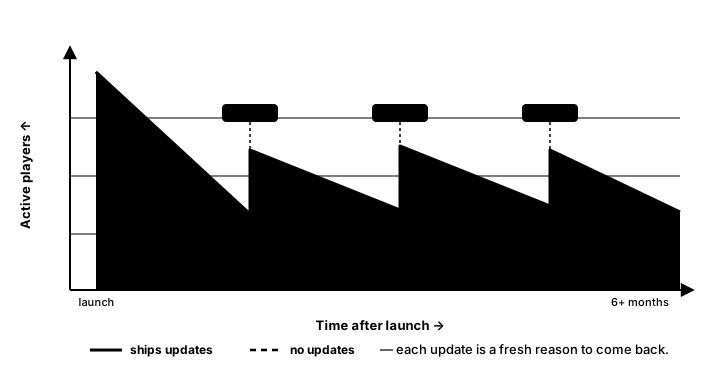
Update Roadmap
🗺️ Planning Your Updates
Update Categories
- Hotfixes: Critical bug fixes (24-48 hours)
- Patches: Minor fixes and balance (weekly)
- Content Updates: New features (monthly)
- Major Updates: Significant additions (quarterly)
- DLC/Expansions: Paid content (bi-annually)
Priority System
- 🔴 Critical: Game-breaking bugs
- 🟠 High: Major functionality issues
- 🟡 Medium: Quality of life improvements
- 🟢 Low: Nice-to-have features
- 🔵 Wishlist: Future considerations
Community Engagement
💬 Maintaining Community
Communication Channels
- Patch Notes: Detailed change logs
- Dev Blogs: Behind-the-scenes insights
- Community Events: Contests and challenges
- Roadmap Sharing: Transparency about future
- Player Feedback: Active listening and response
Response Templates
Bug Report Response:
"Thank you for reporting this issue! We've identified the problem
and it will be fixed in the next patch (v1.0.2) releasing this Friday."

Feature Request Response:
"Great suggestion! We've added this to our roadmap for consideration
in our Q3 update. Keep the feedback coming!"

Negative Review Response:
"We're sorry you had this experience. We've addressed [specific issue]
in our latest update. Please give it another try and let us know if
you still encounter problems."
Content Strategy
🎁 Free vs Paid Content
| Free Updates | Paid DLC |
|---|---|
| Bug fixes | New campaigns |
| Balance changes | Character packs |
| QoL improvements | Expansion packs |
| Small features | Cosmetic bundles |
| Seasonal events | Season passes |
Live Service Elements
🔴 Keeping It Fresh
Daily Engagement
- Daily challenges/quests
- Login bonuses
- Rotating game modes
- Limited-time events
Seasonal Content
- Holiday events
- Battle passes
- Themed updates
- Time-limited rewards
Performance Metrics
📊 Key Performance Indicators
Retention Metrics
- D1 Retention: Players returning after 1 day (target: 40%+)
- D7 Retention: Players returning after 7 days (target: 20%+)
- D30 Retention: Players returning after 30 days (target: 10%+)
Engagement Metrics
- DAU (Daily Active Users): Daily player count
- MAU (Monthly Active Users): Monthly player count
- Session Length: Average play time
- Sessions per Day: How often players return
Monetization Metrics
- ARPU: Average Revenue Per User
- ARPPU: Average Revenue Per Paying User
- Conversion Rate: % of players who pay
- LTV: Lifetime Value of players
Long-Term Sustainability
🔄 Game Lifecycle Management
(0-6 months)"] B --> C["Maturity
(6-24 months)"] C --> D["Decline
(2+ years)"] D --> E["End of Life"] B --> F["Frequent Updates"] C --> G["Quarterly Updates"] D --> H["Maintenance Mode"] E --> I["Community Support"]
Phase Strategies
- Growth: Aggressive updates, new features, marketing push
- Maturity: Stable updates, DLC releases, community events
- Decline: Reduced updates, focus on stability, prepare sequel
- End of Life: Final sale, open source consideration, legacy support
Common Pitfalls
⚠️ What to Avoid
- ❌ Ignoring critical bugs while adding features
- ❌ Breaking promises about update schedules
- ❌ Pay-to-win mechanics in competitive games
- ❌ Abandoning the game without notice
- ❌ Ignoring community feedback
- ❌ Over-promising and under-delivering
- ❌ Changing core gameplay without player input
- ❌ Neglecting to celebrate milestones
Success Stories
🌟 Learning from Others
Great Post-Launch Examples
- No Man's Sky: Transformed through persistent updates
- Stardew Valley: Solo dev continuing support for years
- Terraria: "Final" updates that kept coming
- Dead Cells: Regular DLC and free updates balance
- Among Us: Explosive growth handled well
Key Lessons
- Persistence can overcome poor launches
- Community goodwill is earned through consistency
- Free updates build trust for paid content
- Transparency about development challenges helps
- Small teams can compete through dedication
Technical Considerations
🔧 Update Infrastructure
Version Control
# Semantic Versioning
MAJOR.MINOR.PATCH

1.0.0 - Initial release
1.0.1 - Bug fixes
1.1.0 - New features
2.0.0 - Major changes/breaking compatibility
Update Delivery
- Steam: Automatic updates, beta branches
- itch.io: Butler for incremental patches
- Mobile: App store review process (plan ahead)
- Console: Certification requirements (1-2 weeks)
Save Compatibility
- Always maintain backward compatibility
- Version save files
- Provide migration tools if needed
- Test thoroughly before release
Best Practices
✨ Post-Launch Best Practices
- Day 1 Readiness: Have hotfix process ready
- Quick Response: Address critical issues within 24-48 hours
- Regular Schedule: Predictable update cadence
- Clear Communication: Detailed patch notes
- Community First: Prioritize player-requested features
- Data-Driven: Use analytics to guide decisions
- Quality Control: Test updates thoroughly
- Plan Ahead: Have 3-6 month roadmap
- Stay Flexible: Adapt based on player needs
- Celebrate Success: Share milestones with community
Key Takeaways
- 🚀 Launch is just the beginning of the journey
- 🐛 Fix critical bugs before adding new features
- 📅 Maintain a consistent update schedule
- 👥 Your community is your greatest asset
- 📊 Track metrics but don't be enslaved by them
- 💰 Balance free updates with sustainable monetization
- 🔄 Plan for the entire game lifecycle
- 💬 Communicate openly and frequently
Congratulations!
🎉 You've Completed Section 4: Publishing Your Game!
You now have the knowledge to:
- ✅ Optimize your game's performance
- ✅ Build professional executables
- ✅ Choose and use distribution platforms
- ✅ Market your game effectively
- ✅ Support and grow your game post-launch
You're ready to publish and maintain a successful game!
🏋️♂️ Practice Exercise
🏋️♂️ Exercise 1: Five Tiers, Three Pipelines, One Game — CADENCES Dict + MIGRATIONS Chain + Live-Ops Decoupling in One Pygame Window
Objective: Build a single ~90-line pygame demo that exercises three orthogonal post-launch update disciplines simultaneously: (a) update tiers as data via a CADENCES dict mapping tier name to (cadence_hours, priority, semver_field, color) tuple — five entries hotfix/patch/content/major/dlc — that drives both the auto-ship loop and the per-tier visualization, so adding a sixth tier (e.g., seasonal) is a single dict-entry edit rather than scattered if/elif branches across the planner, ship script, and dashboard; (b) save-format backward compat as a chained handshake via a MIGRATIONS dict keyed by (from_version, to_version) tuples mapping to per-step migration functions, with load_save() walking the chain v1→v2→v3→…→target so each migration is a frozen contract that knows exactly which fields to add/rename/default for its specific version pair, extending an earlier lesson's schema-as-frozen-contract pattern from 'one frozen contract' to 'a chain of frozen contracts that bridge between adjacent versions' (c) live-ops vs binary-update temporal decoupling where daily challenges, seasonal events, and login bonuses roll over on calendar boundaries (server-side day-rollover, date windows) completely independent of binary update cadence (which runs on Steam's update cadence ~weeks or app store review 1–2 weeks), with the two pipelines composing via the shared 'today's date' anchor but neither blocking the other — a delayed binary patch doesn't pause Halloween skins, a holiday event ending doesn't break the binary. Three independent disciplines, three keyboard surfaces, one pygame window where each axis is visible per frame as a concrete UI region.
Instructions:
- Open an 1088×540 pygame window with three labeled regions: left panel (10–490) titled Update Cadences (CADENCES dict), top-right panel (500–1078) titled SemVer + Save Migration, bottom panel (10–1078) titled Live-Ops vs Binary Updates (independent pipelines).
- Define
CADENCES = {tier: (cadence_hours, priority, semver_field, color)}with five entries: hotfix (48h, Critical, patch, red), patch (168h, High, patch, orange), content (720h, Medium, minor, yellow), major (2160h, Medium, major, green), dlc (4380h, Low, major, blue). - Run a sim-time clock advancing 12 hours per real second. Maintain per-tier
elapsed = {tier: 0.0}counters; each frame, increment elapsed[t] by sim-hours-this-frame and callship(t)when elapsed[t] reaches CADENCES[t][0]. Iterate the entire CADENCES dict viafor t in CADENCES— never branch on tier names. - Define
MIGRATIONS = {(from_v, to_v): fn}with three chained migrations: v1→v2 addscurrency: 0, v2→v3 renameshp→health, v3→v4 addsinventory: []. Implementload_save(raw, target)that walks the chain: while raw['version'] < target, dispatchMIGRATIONS[(cur, cur+1)]. - Maintain live-ops state separately from semver state:
live = {'daily': str, 'season': bool, 'login': bool}. Bind D = day rollover (regenerate daily challenge, reset login_claimed); S = toggle season active; L = claim login bonus. None of these bumps semver — they are calendar-driven, not binary-driven. - Bind keys 1–5 to manual ship of hotfix/patch/content/major/dlc; key 4 (major) additionally bumps
SAVE_FMTto simulate when a save-format migration becomes necessary; key M loads the legacyold_save = {'version': 1, 'hp': 100}through the migration chain to current SAVE_FMT and shows the resulting dict. - Render each frame: left panel = five horizontal cadence bars filling toward each tier's cadence_hours threshold (color from CADENCES); top-right = current SemVer string + save-format version + old_save and migrated dicts side-by-side + MIGRATIONS keys list; bottom = sim_day counter, daily challenge string, season-active and login-claimed booleans, binary version (echoed from semver), and a separator note '(daily/season/login roll on day boundary; binary ships on cadence boundary)' making the temporal decoupling visible as text.
💡 Hint
Three axes, three independent levers, one shared screen. The CADENCES dict is the post-launch update schedule expressed as data — every site that touches tiers (the auto-ship loop in update(), the bar renderer in render(), a future 'what tier is overdue?' report) iterates the same dict, so adding a sixth tier is a single edit at one source-of-truth, not a coordinated multi-site refactor. The MIGRATIONS dict is the same idea applied at a different scope: each (from_v, to_v) key declares a frozen contract for one version transition, and load_save() chains them by walking from raw['version'] up to the target version. The trick is that no migration ever needs to know about non-adjacent versions; v1→v2 doesn't care that v4 will eventually exist, because v3→v4 will handle that step when its turn comes. Live-ops is the third lever: daily challenges, seasonal events, and login bonuses are server-side calendar logic that the binary was already coded to honor at v1.0.0 — flipping today's date is enough to activate Halloween content without shipping a new binary, and conversely, shipping a hotfix doesn't reset the daily challenge. The shared anchor (today's date) is what lets the two pipelines compose without either blocking the other. When you find yourself writing if/elif on tier names, version numbers, or platform names, that is the cue to externalize into a dict and iterate.
✅ Example Solution
import pygame, random

W, H = 1088, 540
pygame.init()
screen = pygame.display.set_mode((W, H))
pygame.display.set_caption("Five Tiers, Three Pipelines, One Game")
font = pygame.font.SysFont("consolas", 14)
big  = pygame.font.SysFont("consolas", 18, bold=True)

# Axis A: CADENCES dict externalizes update tiers as data (UPDATE-CADENCE scope)
CADENCES = {
    "hotfix":  (48,    "Critical", "patch", (255,  80,  80)),
    "patch":   (168,   "High",     "patch", (255, 160,  80)),
    "content": (720,   "Medium",   "minor", (255, 220,  80)),
    "major":   (2160,  "Medium",   "major", ( 80, 200, 100)),
    "dlc":     (4380,  "Low",      "major", (100, 140, 255)),
}

# Axis B: MIGRATIONS dict; load_save walks the chain (SAVE-MIGRATION scope)
def m12(s): return {**s, "version": 2, "currency": 0}
def m23(s): return {"version": 3, "health": s.get("hp", 100), "currency": s["currency"]}
def m34(s): return {**s, "version": 4, "inventory": []}
MIGRATIONS = {(1, 2): m12, (2, 3): m23, (3, 4): m34}

def load_save(raw, target):
    cur = dict(raw)
    while cur["version"] < target:
        cur = MIGRATIONS[(cur["version"], cur["version"] + 1)](cur)
    return cur

sver = [1, 0, 0]; SAVE_FMT = 1
sim_day = 0.0; HRS_PER_SEC = 12
elapsed = {t: 0.0 for t in CADENCES}
old_save = {"version": 1, "hp": 100}
migrated = None
live = {"daily": "Defeat 10 enemies", "season": False, "login": False}
log = []

def note(m):
    log.insert(0, m)
    if len(log) > 6: log.pop()

def ship(tier):
    fld = CADENCES[tier][2]
    if   fld == "major": sver[0] += 1; sver[1] = 0; sver[2] = 0
    elif fld == "minor": sver[1] += 1; sver[2] = 0
    elif fld == "patch": sver[2] += 1
    elapsed[tier] = 0.0
    note(f"shipped {tier} -> v{sver[0]}.{sver[1]}.{sver[2]}")

clock = pygame.time.Clock(); running = True
while running:
    dt_s = clock.tick(60) / 1000.0
    dh = dt_s * HRS_PER_SEC
    sim_day += dh / 24.0
    for t in CADENCES:
        elapsed[t] += dh
        if elapsed[t] >= CADENCES[t][0]: ship(t)
    for ev in pygame.event.get():
        if ev.type == pygame.QUIT: running = False
        elif ev.type == pygame.KEYDOWN:
            k = ev.key
            if   k == pygame.K_q: running = False
            elif k == pygame.K_1: ship("hotfix")
            elif k == pygame.K_2: ship("patch")
            elif k == pygame.K_3: ship("content")
            elif k == pygame.K_4: ship("major"); SAVE_FMT += 1; note(f"save fmt -> v{SAVE_FMT}")
            elif k == pygame.K_5: ship("dlc")
            elif k == pygame.K_d:
                sim_day += 1
                live["daily"] = random.choice(["Defeat 10 enemies", "Find 5 chests", "Win 3 PvP", "Craft 7 items"])
                live["login"] = False
                note("day rollover (server-side)")
            elif k == pygame.K_s:
                live["season"] = not live["season"]; note(f"season {'ON' if live['season'] else 'OFF'}")
            elif k == pygame.K_l: live["login"] = True; note("login bonus claimed")
            elif k == pygame.K_m:
                migrated = load_save(old_save, SAVE_FMT)
                note(f"migrated v{old_save['version']} -> v{migrated['version']}")
    screen.fill((20, 24, 32))
    pygame.draw.rect(screen, (35, 40, 50), (10, 10, 480, 250))
    screen.blit(big.render("Update Cadences (CADENCES dict)", True, (255,255,255)), (20, 18))
    y = 50
    for t, (hrs, pri, fld, col) in CADENCES.items():
        r = min(elapsed[t] / hrs, 1.0)
        pygame.draw.rect(screen, (60, 60, 70), (140, y, 250, 20))
        pygame.draw.rect(screen, col, (140, y, int(250 * r), 20))
        screen.blit(font.render(f"{t} ({pri})", True, (255,255,255)), (20, y + 3))
        screen.blit(font.render(f"{int(elapsed[t])}/{hrs}h -> {fld}", True, (220,220,220)), (400, y + 3))
        y += 32
    pygame.draw.rect(screen, (35, 40, 50), (500, 10, 578, 250))
    screen.blit(big.render("SemVer + Save Migration", True, (255,255,255)), (510, 18))
    screen.blit(big.render(f"v{sver[0]}.{sver[1]}.{sver[2]}", True, (120,220,120)), (510, 50))
    screen.blit(font.render(f"save format version: v{SAVE_FMT}", True, (200,200,255)), (510, 90))
    screen.blit(font.render(f"old_save = {old_save}", True, (180,180,180)), (510, 115))
    screen.blit(font.render(f"migrated = {migrated}" if migrated else "(press M to migrate)", True, (255,220,140)), (510, 138))
    screen.blit(font.render(f"MIGRATIONS keys: {list(MIGRATIONS.keys())}", True, (180,180,255)), (510, 165))
    pygame.draw.rect(screen, (35, 40, 50), (10, 270, 1068, 200))
    screen.blit(big.render("Live-Ops vs Binary Updates (independent pipelines)", True, (255,255,255)), (20, 280))
    screen.blit(font.render(f"sim day: {int(sim_day)}", True, (255,255,255)), (20, 310))
    screen.blit(font.render(f"daily challenge (server-side): {live['daily']}", True, (200,255,200)), (20, 332))
    screen.blit(font.render(f"season active: {live['season']}   login claimed: {live['login']}", True, (200,255,200)), (20, 354))
    screen.blit(font.render(f"binary version (Steam side): v{sver[0]}.{sver[1]}.{sver[2]}", True, (255,200,200)), (20, 380))
    screen.blit(font.render("(daily/season/login roll on day boundary; binary ships on cadence boundary)", True, (180,180,180)), (20, 408))
    pygame.draw.rect(screen, (35, 40, 50), (10, 480, 1068, 50))
    screen.blit(font.render("[1-5] ship tier  [M] migrate save  [D] day rollover  [S] toggle season  [L] claim login  [Q] quit", True, (200,200,200)), (20, 488))
    screen.blit(font.render(f"log: {' | '.join(log[:3])}", True, (255,220,140)), (20, 510))
    pygame.display.flip()

pygame.quit()
🎯 Quick Quiz
Question 1: A team's roadmap planner, ship script, and dashboard all currently contain the same five-way if update_type == 'hotfix': cadence = 48; priority = 'Critical' elif update_type == 'patch': cadence = 168; priority = 'High' elif update_type == 'content': cadence = 720 elif update_type == 'major': cadence = 2160 elif update_type == 'dlc': cadence = 4380 branch. Product wants to add a sixth tier seasonal (every 2160 hours, Medium priority) for holiday-event content. What is the canonical refactor?
Question 2: Your game v1.0.0 shipped with a save format {'version': 1, 'hp': 100}. v2.0.0 added currency: 0. v3.0.0 renamed hp to health. v4.0.0 added inventory: []. A player who hasn't launched in months has a v1 save file and just installed v4.0.0. What is the canonical loader pattern?
Question 3: Your game has daily challenges (rotate at server midnight), seasonal Halloween skins (active Oct 15–Nov 5), and a Steam binary update cadence (hotfix as needed; major every quarter). The Halloween skin needs to activate on Oct 15 even though no binary update ships until Oct 17 (next hotfix slot). What is the canonical architecture?