Socket Programming
Building Network Communication for Games
Master the fundamentals of socket programming! Learn how to create networked games using TCP and UDP protocols, implement real-time communication, and handle multiple clients! 🌐🎮🔌
Understanding Sockets
🔌 What Are Sockets?
A socket is an endpoint for network communication. Think of it as a telephone - you need one on each end to have a conversation!
- IP Address: The "phone number" - identifies the computer
- Port: The "extension" - identifies the specific application
- Protocol: The "language" - how data is formatted (TCP or UDP)
- Socket: The combination of IP + Port + Protocol
192.168.1.100:5000"] -->|"Data Flow"| B["Server Socket
192.168.1.50:8080"] B -->|"Response"| A C["Client Process"] --> A B --> D["Server Process"] style A fill:#e1f5fe style B fill:#fff3e0 style C fill:#c8e6c9 style D fill:#ffccbc
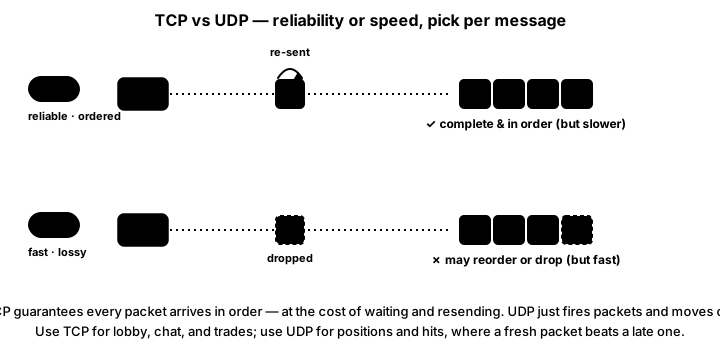
TCP vs UDP
📡 Choosing the Right Protocol
| Aspect | TCP | UDP |
|---|---|---|
| Connection | Connection-oriented | Connectionless |
| Reliability | Guaranteed delivery | No guarantee |
| Order | Ordered packets | May arrive out of order |
| Speed | Slower | Faster |
| Use in Games | Turn-based, chat, login | Real-time action, position updates |
Basic TCP Socket Implementation
🔧 TCP Server and Client
TCP Server
import socket
import threading
import json
from typing import Dict, List, Optional, Any, Tuple

class GameServer:
    def __init__(self, host: str = 'localhost', port: int = 5555) -> None:
        self.host: str = host
        self.port: int = port
        self.server: socket.socket = socket.socket(socket.AF_INET, socket.SOCK_STREAM)
        self.clients: Dict[socket.socket, Dict[str, Any]] = {}  # {client_socket: player_data}
        self.running: bool = False

    def start(self) -> None:
        """Start the server"""
        # Allow reuse of address
        self.server.setsockopt(socket.SOL_SOCKET, socket.SO_REUSEADDR, 1)

        # Bind to address and port
        self.server.bind((self.host, self.port))

        # Listen for connections (max 5 queued)
        self.server.listen(5)
        self.running = True

        print(f"Server listening on {self.host}:{self.port}")

        # Accept connections in a loop
        while self.running:
            try:
                client_socket, address = self.server.accept()
                print(f"New connection from {address}")

                # Handle each client in a separate thread
                client_thread = threading.Thread(
                    target=self.handle_client,
                    args=(client_socket, address)
                )
                client_thread.start()

            except Exception as e:
                print(f"Error accepting connection: {e}")

    def handle_client(self, client_socket: socket.socket, address: Tuple[str, int]) -> None:
        """Handle individual client connection"""
        # Initialize player data
        player_id = f"player_{len(self.clients)}"
        self.clients[client_socket] = {
            'id': player_id,
            'address': address,
            'x': 100,
            'y': 100,
            'score': 0
        }

        # Send welcome message
        welcome_msg = {
            'type': 'welcome',
            'player_id': player_id,
            'message': 'Connected to game server!'
        }
        self.send_to_client(client_socket, welcome_msg)

        # Broadcast new player to others
        self.broadcast({
            'type': 'player_joined',
            'player_id': player_id
        }, exclude=client_socket)

        # Main client loop
        while self.running:
            try:
                # Receive data (max 4096 bytes)
                # NOTE: recv() does NOT preserve message boundaries - one recv() may
                # return a partial message OR several joined together. A real server
                # needs the length-prefix framing shown in "Message Framing" below.
                data = client_socket.recv(4096).decode('utf-8')

                if not data:
                    break

                # Parse JSON message
                message = json.loads(data)
                self.process_message(client_socket, message)

            except ConnectionResetError:
                print(f"Client {address} disconnected abruptly")
                break
            except json.JSONDecodeError:
                print(f"Invalid JSON from {address}")
            except Exception as e:
                print(f"Error handling client {address}: {e}")
                break

        # Clean up on disconnect
        self.remove_client(client_socket)

    def process_message(self, client_socket: socket.socket, message: Dict[str, Any]) -> None:
        """Process incoming message from client"""
        msg_type = message.get('type')
        player = self.clients[client_socket]

        if msg_type == 'move':
            # Update player position
            player['x'] = message.get('x', player['x'])
            player['y'] = message.get('y', player['y'])

            # Broadcast position to all clients
            self.broadcast({
                'type': 'player_moved',
                'player_id': player['id'],
                'x': player['x'],
                'y': player['y']
            })

        elif msg_type == 'chat':
            # Broadcast chat message
            self.broadcast({
                'type': 'chat',
                'player_id': player['id'],
                'message': message.get('message', '')
            })

        elif msg_type == 'get_players':
            # Send list of all players
            players_list = [
                {
                    'id': p['id'],
                    'x': p['x'],
                    'y': p['y'],
                    'score': p['score']
                }
                for p in self.clients.values()
            ]
            self.send_to_client(client_socket, {
                'type': 'players_list',
                'players': players_list
            })

    def send_to_client(self, client_socket: socket.socket, message: Dict[str, Any]) -> None:
        """Send message to specific client"""
        try:
            json_msg = json.dumps(message)
            client_socket.send(json_msg.encode('utf-8'))
        except Exception as e:
            print(f"Error sending to client: {e}")

    def broadcast(self, message: Dict[str, Any], exclude: Optional[socket.socket] = None) -> None:
        """Broadcast message to all clients"""
        json_msg = json.dumps(message)

        for client_socket in list(self.clients.keys()):
            if client_socket != exclude:
                try:
                    client_socket.send(json_msg.encode('utf-8'))
                except:
                    # Remove dead connections
                    self.remove_client(client_socket)

    def remove_client(self, client_socket: socket.socket) -> None:
        """Remove client from server"""
        if client_socket in self.clients:
            player_id = self.clients[client_socket]['id']
            del self.clients[client_socket]

            # Notify others
            self.broadcast({
                'type': 'player_left',
                'player_id': player_id
            })

            client_socket.close()
            print(f"Client {player_id} disconnected")

    def stop(self) -> None:
        """Stop the server"""
        self.running = False
        for client in list(self.clients.keys()):
            client.close()
        self.server.close()

# TCP Client
class GameClient:
    def __init__(self) -> None:
        self.socket: Optional[socket.socket] = None
        self.connected: bool = False
        self.player_id: Optional[str] = None
        self.receive_thread: Optional[threading.Thread] = None

    def connect(self, host: str = 'localhost', port: int = 5555) -> bool:
        """Connect to game server"""
        try:
            self.socket = socket.socket(socket.AF_INET, socket.SOCK_STREAM)
            self.socket.connect((host, port))
            self.connected = True

            # Start receiving thread
            self.receive_thread = threading.Thread(target=self.receive_loop)
            self.receive_thread.daemon = True
            self.receive_thread.start()

            print(f"Connected to {host}:{port}")
            return True

        except Exception as e:
            print(f"Failed to connect: {e}")
            return False

    def receive_loop(self) -> None:
        """Continuously receive messages from server"""
        while self.connected:
            try:
                # Same caveat as the server: recv() is not message-framed - see
                # "Message Framing" below for the length-prefix fix.
                data = self.socket.recv(4096).decode('utf-8')
                if not data:
                    break

                message = json.loads(data)
                self.handle_message(message)

            except Exception as e:
                print(f"Receive error: {e}")
                break

        self.disconnect()

    def handle_message(self, message: Dict[str, Any]) -> None:
        """Handle incoming message from server"""
        msg_type = message.get('type')

        if msg_type == 'welcome':
            self.player_id = message.get('player_id')
            print(f"Assigned ID: {self.player_id}")
            print(message.get('message'))

        elif msg_type == 'player_joined':
            print(f"Player {message.get('player_id')} joined the game")

        elif msg_type == 'player_left':
            print(f"Player {message.get('player_id')} left the game")

        elif msg_type == 'player_moved':
            player_id = message.get('player_id')
            x = message.get('x')
            y = message.get('y')
            print(f"Player {player_id} moved to ({x}, {y})")

        elif msg_type == 'chat':
            player_id = message.get('player_id')
            chat_msg = message.get('message')
            print(f"[{player_id}]: {chat_msg}")

    def send_message(self, message: Dict[str, Any]) -> bool:
        """Send message to server"""
        if self.connected and self.socket:
            try:
                json_msg = json.dumps(message)
                self.socket.send(json_msg.encode('utf-8'))
                return True
            except Exception as e:
                print(f"Send error: {e}")
                return False
        return False

    def move(self, x: int, y: int) -> bool:
        """Send movement update"""
        return self.send_message({
            'type': 'move',
            'x': x,
            'y': y
        })

    def chat(self, message: str) -> bool:
        """Send chat message"""
        return self.send_message({
            'type': 'chat',
            'message': message
        })

    def disconnect(self) -> None:
        """Disconnect from server"""
        self.connected = False
        if self.socket:
            self.socket.close()
            print("Disconnected from server")

# Example usage
if __name__ == "__main__":
    import sys

    if len(sys.argv) > 1 and sys.argv[1] == 'server':
        # Run as server
        server = GameServer()
        try:
            server.start()
        except KeyboardInterrupt:
            print("\nShutting down server...")
            server.stop()
    else:
        # Run as client
        client = GameClient()
        if client.connect():
            # Simple command loop
            while client.connected:
                try:
                    cmd = input("Enter command (move x y, chat msg, quit): ")
                    parts = cmd.split(' ', 2)

                    if parts[0] == 'quit':
                        break
                    elif parts[0] == 'move' and len(parts) >= 3:
                        x = int(parts[1])
                        y = int(parts[2])
                        client.move(x, y)
                    elif parts[0] == 'chat' and len(parts) >= 2:
                        client.chat(parts[1])

                except KeyboardInterrupt:
                    break
                except Exception as e:
                    print(f"Error: {e}")

            client.disconnect()
UDP Socket Implementation
⚡ UDP for Real-Time Games
import socket
import json
import time
import struct
import threading
from typing import Dict, Optional, Any, Tuple

class UDPGameServer:
    def __init__(self, host: str = 'localhost', port: int = 5556) -> None:
        self.host: str = host
        self.port: int = port
        self.socket: socket.socket = socket.socket(socket.AF_INET, socket.SOCK_DGRAM)
        self.clients: Dict[Tuple[str, int], Dict[str, Any]] = {}  # {address: {last_seen, player_data}}
        self.running: bool = False
        self.sequence_number: int = 0

    def start(self) -> None:
        """Start UDP server"""
        self.socket.bind((self.host, self.port))
        self.running = True

        print(f"UDP Server listening on {self.host}:{self.port}")

        # Start cleanup thread
        cleanup_thread = threading.Thread(target=self.cleanup_inactive_clients)
        cleanup_thread.daemon = True
        cleanup_thread.start()

        # Main receive loop
        while self.running:
            try:
                # Receive datagram
                data, address = self.socket.recvfrom(1024)

                # Process in separate thread for non-blocking
                threading.Thread(
                    target=self.handle_packet,
                    args=(data, address)
                ).start()

            except Exception as e:
                print(f"Error receiving packet: {e}")

    def handle_packet(self, data: bytes, address: Tuple[str, int]) -> None:
        """Handle incoming UDP packet"""
        try:
            # Parse packet
            message = json.loads(data.decode('utf-8'))

            # Update client last seen time
            if address not in self.clients:
                # New client
                player_id = f"player_{len(self.clients)}"
                self.clients[address] = {
                    'last_seen': time.time(),
                    'player_id': player_id,
                    'x': 100,
                    'y': 100,
                    'vx': 0,
                    'vy': 0,
                    'sequence': 0
                }

                # Send acknowledgment
                self.send_to_client(address, {
                    'type': 'connected',
                    'player_id': player_id
                })

                print(f"New UDP client: {address}")
            else:
                self.clients[address]['last_seen'] = time.time()

            # Process message
            self.process_packet(address, message)

        except json.JSONDecodeError:
            print(f"Invalid JSON from {address}")
        except Exception as e:
            print(f"Error handling packet: {e}")

    def process_packet(self, address: Tuple[str, int], message: Dict[str, Any]) -> None:
        """Process UDP message"""
        client = self.clients[address]
        msg_type = message.get('type')

        # Check sequence number for ordering
        seq = message.get('sequence', 0)
        if seq <= client['sequence'] and msg_type != 'ping':
            return  # Ignore old packets
        client['sequence'] = seq

        if msg_type == 'update':
            # Position update
            client['x'] = message.get('x', client['x'])
            client['y'] = message.get('y', client['y'])
            client['vx'] = message.get('vx', 0)
            client['vy'] = message.get('vy', 0)

            # Broadcast state to all clients
            self.broadcast_state()

        elif msg_type == 'ping':
            # Respond to ping
            self.send_to_client(address, {
                'type': 'pong',
                'timestamp': message.get('timestamp', time.time())
            })

    def broadcast_state(self) -> None:
        """Broadcast game state to all clients"""
        # Prepare state snapshot
        state = {
            'type': 'state',
            'timestamp': time.time(),
            'sequence': self.sequence_number,
            'players': []
        }

        for addr, client in self.clients.items():
            state['players'].append({
                'id': client['player_id'],
                'x': client['x'],
                'y': client['y'],
                'vx': client['vx'],
                'vy': client['vy']
            })

        # Send to all clients
        for address in self.clients.keys():
            self.send_to_client(address, state)

        self.sequence_number += 1

    def send_to_client(self, address: Tuple[str, int], message: Dict[str, Any]) -> None:
        """Send message to specific client"""
        try:
            data = json.dumps(message).encode('utf-8')
            self.socket.sendto(data, address)
        except Exception as e:
            print(f"Error sending to {address}: {e}")

    def cleanup_inactive_clients(self) -> None:
        """Remove inactive clients"""
        while self.running:
            time.sleep(5)  # Check every 5 seconds
            current_time = time.time()

            # Remove clients inactive for 10+ seconds
            inactive = []
            for address, client in self.clients.items():
                if current_time - client['last_seen'] > 10:
                    inactive.append(address)

            for address in inactive:
                print(f"Removing inactive client: {address}")
                del self.clients[address]

    def stop(self) -> None:
        """Stop server"""
        self.running = False
        self.socket.close()

class UDPGameClient:
    def __init__(self) -> None:
        self.socket: socket.socket = socket.socket(socket.AF_INET, socket.SOCK_DGRAM)
        self.server_address: Optional[Tuple[str, int]] = None
        self.player_id: Optional[str] = None
        self.sequence_number: int = 0
        self.last_ping: float = 0
        self.latency: float = 0
        self.running: bool = False

    def connect(self, host: str = 'localhost', port: int = 5556) -> bool:
        """Connect to UDP server"""
        self.server_address = (host, port)
        self.running = True

        # Start receive thread
        receive_thread = threading.Thread(target=self.receive_loop)
        receive_thread.daemon = True
        receive_thread.start()

        # Send initial connection packet
        self.send_message({'type': 'connect'})

        # Start ping thread
        ping_thread = threading.Thread(target=self.ping_loop)
        ping_thread.daemon = True
        ping_thread.start()

        print(f"Connecting to UDP server at {host}:{port}")
        return True

    def receive_loop(self) -> None:
        """Receive packets from server"""
        while self.running:
            try:
                data, address = self.socket.recvfrom(1024)
                message = json.loads(data.decode('utf-8'))
                self.handle_message(message)

            except Exception as e:
                print(f"Receive error: {e}")

    def handle_message(self, message: Dict[str, Any]) -> None:
        """Handle server message"""
        msg_type = message.get('type')

        if msg_type == 'connected':
            self.player_id = message.get('player_id')
            print(f"Connected as {self.player_id}")

        elif msg_type == 'state':
            # Game state update
            players = message.get('players', [])
            for player in players:
                if player['id'] != self.player_id:
                    # Update other players
                    print(f"Player {player['id']}: ({player['x']}, {player['y']})")

        elif msg_type == 'pong':
            # Calculate latency
            self.latency = (time.time() - message.get('timestamp', 0)) * 1000
            print(f"Latency: {self.latency:.1f}ms")

    def send_message(self, message: Dict[str, Any]) -> bool:
        """Send message to server"""
        if self.server_address:
            try:
                message['sequence'] = self.sequence_number
                self.sequence_number += 1

                data = json.dumps(message).encode('utf-8')
                self.socket.sendto(data, self.server_address)
                return True

            except Exception as e:
                print(f"Send error: {e}")
                return False
        return False

    def send_position(self, x: float, y: float, vx: float = 0, vy: float = 0) -> bool:
        """Send position update"""
        return self.send_message({
            'type': 'update',
            'x': x,
            'y': y,
            'vx': vx,
            'vy': vy
        })

    def ping_loop(self) -> None:
        """Send periodic pings to measure latency"""
        while self.running:
            time.sleep(1)  # Ping every second
            self.send_message({
                'type': 'ping',
                'timestamp': time.time()
            })

    def disconnect(self) -> None:
        """Disconnect from server"""
        self.running = False
        self.socket.close()
        print("Disconnected")
Game Integration Example
🎮 Pygame Network Game
import pygame
import threading
from typing import Dict, Optional, Any
from game_client import GameClient  # Our TCP client from above

class NetworkedGame:
    def __init__(self) -> None:
        pygame.init()
        self.screen: pygame.Surface = pygame.display.set_mode((800, 600))
        pygame.display.set_caption("Networked Game")
        self.clock: pygame.time.Clock = pygame.time.Clock()

        # Network client
        self.client: GameClient = GameClient()
        self.connected: bool = False

        # Game state
        self.players: Dict[str, Dict[str, Any]] = {}  # {player_id: {'x': x, 'y': y, 'color': color}}
        self.my_player: Optional[str] = None

        # Connect to server
        self.connect_to_server()

    def connect_to_server(self) -> None:
        """Connect to game server"""
        if self.client.connect('localhost', 5555):
            self.connected = True

            # Override client's message handler
            self.client.handle_message = self.handle_network_message

            print("Connected to server!")
        else:
            print("Failed to connect to server")

    def handle_network_message(self, message: Dict[str, Any]) -> None:
        """Handle messages from server"""
        msg_type = message.get('type')

        if msg_type == 'welcome':
            # Create our player
            player_id = message.get('player_id')
            self.my_player = player_id
            self.players[player_id] = {
                'x': 400,
                'y': 300,
                'color': (0, 255, 0)  # Green for our player
            }

        elif msg_type == 'player_joined':
            # Add new player
            player_id = message.get('player_id')
            if player_id not in self.players:
                self.players[player_id] = {
                    'x': 100,
                    'y': 100,
                    'color': (255, 0, 0)  # Red for others
                }

        elif msg_type == 'player_left':
            # Remove player
            player_id = message.get('player_id')
            if player_id in self.players:
                del self.players[player_id]

        elif msg_type == 'player_moved':
            # Update player position
            player_id = message.get('player_id')
            if player_id in self.players:
                self.players[player_id]['x'] = message.get('x')
                self.players[player_id]['y'] = message.get('y')

        elif msg_type == 'players_list':
            # Sync all players
            for player_data in message.get('players', []):
                player_id = player_data['id']
                if player_id not in self.players:
                    color = (0, 255, 0) if player_id == self.my_player else (255, 0, 0)
                    self.players[player_id] = {
                        'x': player_data['x'],
                        'y': player_data['y'],
                        'color': color
                    }

    def run(self) -> None:
        """Main game loop"""
        running = True

        while running:
            dt = self.clock.tick(60) / 1000.0  # 60 FPS

            # Handle events
            for event in pygame.event.get():
                if event.type == pygame.QUIT:
                    running = False
                elif event.type == pygame.KEYDOWN:
                    if event.key == pygame.K_SPACE:
                        # Request player list
                        self.client.send_message({'type': 'get_players'})

            # Handle input
            if self.connected and self.my_player:
                keys = pygame.key.get_pressed()
                player = self.players.get(self.my_player)

                if player:
                    moved = False
                    speed = 200  # pixels per second

                    if keys[pygame.K_LEFT]:
                        player['x'] -= speed * dt
                        moved = True
                    if keys[pygame.K_RIGHT]:
                        player['x'] += speed * dt
                        moved = True
                    if keys[pygame.K_UP]:
                        player['y'] -= speed * dt
                        moved = True
                    if keys[pygame.K_DOWN]:
                        player['y'] += speed * dt
                        moved = True

                    # Keep player on screen
                    player['x'] = max(20, min(780, player['x']))
                    player['y'] = max(20, min(580, player['y']))

                    # Send position to server
                    if moved:
                        self.client.move(int(player['x']), int(player['y']))

            # Draw everything
            self.screen.fill((30, 30, 30))

            # Draw players
            for player_id, player_data in self.players.items():
                x = int(player_data['x'])
                y = int(player_data['y'])
                color = player_data['color']

                # Draw player circle
                pygame.draw.circle(self.screen, color, (x, y), 20)

                # Draw player ID
                font = pygame.font.Font(None, 24)
                text = font.render(player_id, True, (255, 255, 255))
                text_rect = text.get_rect(center=(x, y - 30))
                self.screen.blit(text, text_rect)

            # Draw connection status
            status_color = (0, 255, 0) if self.connected else (255, 0, 0)
            status_text = "Connected" if self.connected else "Disconnected"
            font = pygame.font.Font(None, 36)
            text = font.render(status_text, True, status_color)
            self.screen.blit(text, (10, 10))

            # Draw instructions
            font = pygame.font.Font(None, 24)
            instructions = [
                "Arrow Keys: Move",
                "Space: Sync Players",
                "ESC: Quit"
            ]
            for i, instruction in enumerate(instructions):
                text = font.render(instruction, True, (200, 200, 200))
                self.screen.blit(text, (10, 550 + i * 20))

            pygame.display.flip()

        # Clean up
        if self.connected:
            self.client.disconnect()
        pygame.quit()

if __name__ == "__main__":
    game = NetworkedGame()
    game.run()
Advanced Socket Concepts
🔬 Advanced Techniques
1. Non-blocking Sockets
import socket
import select

# Make socket non-blocking
sock = socket.socket(socket.AF_INET, socket.SOCK_STREAM)
sock.setblocking(False)

# Use select for multiplexing
readable, writable, errors = select.select([sock], [], [], timeout=0.1)
if readable:
    data = sock.recv(1024)
2. Message Framing
def send_message_with_length(sock, message):
    """Send message with length prefix"""
    data = message.encode('utf-8')
    length = len(data)

    # Send 4-byte length prefix
    sock.send(struct.pack('!I', length))
    # Send actual data
    sock.send(data)

def receive_message_with_length(sock):
    """Receive message with length prefix"""
    # Receive length prefix
    length_data = sock.recv(4)
    if not length_data:
        return None

    length = struct.unpack('!I', length_data)[0]

    # Receive exact amount of data
    data = b''
    while len(data) < length:
        chunk = sock.recv(min(4096, length - len(data)))
        if not chunk:
            return None
        data += chunk

    return data.decode('utf-8')
3. Connection Pooling
class ConnectionPool:
    def __init__(self, max_connections: int = 10) -> None:
        self.pool: list = []
        self.max_connections: int = max_connections

    def get_connection(self, host: str, port: int):
        # Reuse existing connection if available
        for conn in self.pool:
            if not conn.in_use:
                conn.in_use = True
                return conn

        # Create new connection if under limit
        if len(self.pool) < self.max_connections:
            conn = self.create_connection(host, port)
            self.pool.append(conn)
            return conn

        return None  # Pool exhausted
Security Considerations
🔒 Socket Security
- Input Validation: Always validate incoming data
- Buffer Limits: Set maximum message sizes
- Rate Limiting: Prevent spam/DoS attacks
- Encryption: Use SSL/TLS for sensitive data
- Authentication: Verify client identities
- Timeout Handling: Set socket timeouts
# Example: Rate limiting
class RateLimiter:
    def __init__(self, max_requests: int = 10, time_window: float = 1.0) -> None:
        self.max_requests: int = max_requests
        self.time_window: float = time_window
        self.clients: dict = {}  # {address: [timestamps]}

    def is_allowed(self, address) -> bool:
        current_time = time.time()

        if address not in self.clients:
            self.clients[address] = []

        # Remove old timestamps
        self.clients[address] = [
            t for t in self.clients[address]
            if current_time - t < self.time_window
        ]

        # Check rate limit
        if len(self.clients[address]) < self.max_requests:
            self.clients[address].append(current_time)
            return True

        return False
Debugging Network Code
🐛 Debugging Tools and Tips
1. Packet Logging
import logging

logging.basicConfig(level=logging.DEBUG,
                   format='%(asctime)s - %(levelname)s - %(message)s')

def log_packet(direction: str, address, data: str) -> None:
    logging.debug(f"{direction} {address}: {data[:100]}")  # First 100 chars
2. Network Monitoring Tools
- Wireshark: Packet analysis
- netstat: View active connections
- tcpdump: Command-line packet capture
- telnet: Test TCP connections
- nc (netcat): Swiss army knife for networking
3. Common Issues
- Connection Refused: Server not running or wrong port
- Address Already in Use: Port still bound from previous run
- Firewall Blocking: Check firewall rules
- Data Corruption: Encoding/decoding issues
- Deadlocks: Improper threading
Best Practices
✨ Socket Programming Best Practices
- Protocol Design: Define clear message formats
- Error Handling: Always handle network errors gracefully
- Resource Cleanup: Always close sockets properly
- Threading Safety: Use locks for shared resources
- Buffer Management: Don't assume message boundaries
- Timeouts: Set appropriate timeouts for operations
- Testing: Test with packet loss and high latency
- Documentation: Document your protocol
- Versioning: Plan for protocol changes
- Monitoring: Log important events
Key Takeaways
- 🔌 Sockets are the foundation of network communication
- 📡 Choose TCP for reliability, UDP for speed
- 🔄 Always handle network errors and disconnections
- 📦 Frame your messages properly for TCP
- ⏱️ Implement timeouts and cleanup inactive connections
- 🔒 Validate all incoming data for security
- 🧵 Use threading for handling multiple clients
- 📊 Monitor and log network activity for debugging
🏋️♂️ Practice Exercise
🏋️♂️ Exercise 1: Concurrent Echo Server with Length-Prefixed Framing
Objective: Build a single-process Python demo (~80 lines) that exercises three pillar TCP patterns from this lesson — the server lifecycle scaffold (socket + SO_REUSEADDR + bind + listen + accept loop spawning threading.Thread per client), TCP message framing via a 4-byte big-endian length prefix (because TCP is a byte-stream, not message-boundary-preserving), and socket lifecycle hygiene (try/finally close, recv-loop buffering, timeouts) — all running in one runnable Python file with two client threads talking to one server thread on localhost so the whole multi-client conversation plays out without needing a second terminal.
Instructions:
- Define a length-prefix framing pair:
send_msg(sock, text)packsstruct.pack('!I', len(payload)) + payloadviasock.sendall, andrecv_msg(sock)reads exactly 4 bytes for the length header in a buffer-until-full loop, unpacks viastruct.unpack('!I', header)[0], then reads exactly that many payload bytes in a second buffer-until-full loop. The recv-loop is essential becausesock.recv(N)can return fewer than N bytes — TCP makes no message-boundary promises, so the application has to frame its own messages. - Write
handle_client(sock, addr)as the per-thread loop:sock.settimeout(5.0)so a stalled client doesn't pin the thread forever, then loop callingrecv_msguntil it returnsNone(clean disconnect) or raisessocket.timeout; for each received message echo back viasend_msg. Wrap the whole thing in try/finally sosock.close()always runs (Best Practice "Resource Cleanup: Always close sockets properly"). - Write the server function:
s = socket.socket(socket.AF_INET, socket.SOCK_STREAM)creates a TCP socket;s.setsockopt(socket.SOL_SOCKET, socket.SO_REUSEADDR, 1)goes BEFOREbindso a fast restart doesn't fail with "Address already in use" (Common Issues "Address Already in Use: Port still bound from previous run");s.bind((HOST, PORT))thens.listen(8)(8 = OS-level pending-accept queue depth, NOT a cap on concurrent connections); finally awhile True: client_sock, addr = s.accept(); threading.Thread(target=handle_client, args=(client_sock, addr), daemon=True).start()loop that spawns one daemon thread per accepted client and immediately returns toaccept()for the next — the thread-per-client pattern that keeps the accept loop unblocked. - Write a client function that sleeps 0.5 s for the server to come up, opens a socket, calls
connect((HOST, PORT)), then loops sending a list of messages viasend_msgand reading the reply viarecv_msg; close in a finally block. Spawn the server thread as a daemon, then spawn TWO client threads with different names ("alice" + "bob") and different message lists — their messages will interleave on the server's stdout, proving the per-client threads run concurrently without blocking each other or the accept loop. - Run the script. Watch the interleaved server-side output: alice's three messages and bob's three messages arrive in arbitrary order (sometimes alice-bob-alice-bob, sometimes alice-alice-bob, depending on thread scheduling), but each client's messages return to that client in the order it sent them — because each client has its own
recv_msgloop on its own socket, the per-client ordering is preserved while the cross-client ordering is not.
💡 Hint
The recv-loops are the whole point of message framing. sock.recv(4) can return 1, 2, 3, or 4 bytes — TCP guarantees the bytes will arrive in order eventually but makes no promise about how many arrive per recv call. The buffer-until-full pattern while len(buf) < needed: chunk = sock.recv(needed - len(buf)); if not chunk: return None; buf += chunk handles all the fragmentation cases. Skipping it works on localhost in test (bytes arrive in one chunk because there is no real network) but breaks the moment you deploy across the public internet (Best Practice "Buffer Management: Don't assume message boundaries").
✅ Example Solution
import socket, struct, threading, time

HOST, PORT = '127.0.0.1', 5555

def send_msg(sock, text):
    payload = text.encode('utf-8')
    sock.sendall(struct.pack('!I', len(payload)) + payload)

def recv_msg(sock):
    header = b''
    while len(header) < 4:
        chunk = sock.recv(4 - len(header))
        if not chunk: return None
        header += chunk
    msg_len = struct.unpack('!I', header)[0]
    body = b''
    while len(body) < msg_len:
        chunk = sock.recv(msg_len - len(body))
        if not chunk: return None
        body += chunk
    return body.decode('utf-8')

def handle_client(sock, addr):
    print(f"[server] connected: {addr}")
    try:
        sock.settimeout(5.0)
        while True:
            msg = recv_msg(sock)
            if msg is None: break
            print(f"[server] from {addr}: {msg}")
            send_msg(sock, f"echo: {msg}")
    except socket.timeout:
        print(f"[server] timeout: {addr}")
    finally:
        sock.close()

def server():
    s = socket.socket(socket.AF_INET, socket.SOCK_STREAM)
    s.setsockopt(socket.SOL_SOCKET, socket.SO_REUSEADDR, 1)
    s.bind((HOST, PORT))
    s.listen(8)
    print(f"[server] listening on {HOST}:{PORT}")
    while True:
        client_sock, addr = s.accept()
        threading.Thread(target=handle_client,
                         args=(client_sock, addr),
                         daemon=True).start()

def client(name, messages):
    time.sleep(0.5)
    s = socket.socket(socket.AF_INET, socket.SOCK_STREAM)
    try:
        s.connect((HOST, PORT))
        for m in messages:
            send_msg(s, f"{name}: {m}")
            reply = recv_msg(s)
            print(f"[{name}] got: {reply}")
            time.sleep(0.2)
    finally:
        s.close()

if __name__ == '__main__':
    threading.Thread(target=server, daemon=True).start()
    threading.Thread(target=client,
                     args=('alice', ['hi', 'how are you?', 'bye'])).start()
    threading.Thread(target=client,
                     args=('bob', ['hello', 'are you there?', 'goodbye'])).start()
    time.sleep(5)
🎯 Quick Quiz
Question 1: The lesson's TCP server uses s.setsockopt(socket.SOL_SOCKET, socket.SO_REUSEADDR, 1) with the explicit comment "Allow reuse of address" BEFORE the call to s.bind. What concrete failure mode does this option prevent on a typical development workflow?
Question 2: Why does the lesson's Best Practice "Buffer Management: Don't assume message boundaries" + Key Takeaway "Frame your messages properly for TCP" mean a naive data = sock.recv(4096); message = json.loads(data) pattern is broken in production, and what does the length-prefix framing pair fix?
Question 3: The lesson's TCP server spawns threading.Thread(target=self.handle_client, args=(client_socket, address)) on every accepted connection. Why is the per-client thread necessary, and what concrete failure mode does the alternative (handling the client inline in the accept loop) cause?
What's Next?
Now that you understand socket programming, let's learn about handling lag and latency in networked games!